

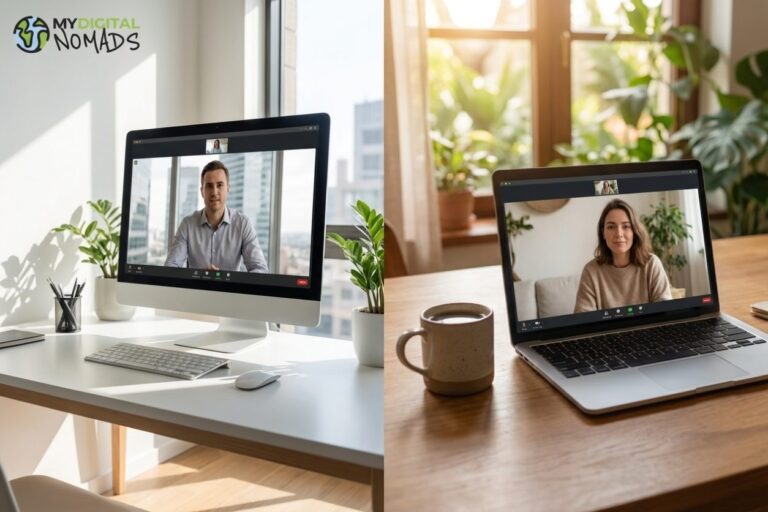
Hybrid work won. That much is clear from the data. About 83% of workers who can work remotely say they prefer a hybrid arrangement over full-time office or full-time remote, according to Gallup’s 2026 research. 51% of remote-capable US workers are already in hybrid setups. The debate about whether hybrid work is viable has been answered.
The question now is whether anyone is doing it well.
From what we see at mydigitalnomads, the answer is: some companies are. Most aren’t. Hybrid work is easy to announce and hard to execute, and the gap between intention and reality is where most teams run into trouble.
What hybrid work looks like in practice
The most common model is 2-3 required office days per week, with the rest flexible. Tuesday to Thursday in the office is the default for a lot of companies, which has created a strange pattern: offices packed mid-week, empty on Mondays and Fridays, and nobody quite sure what the in-office days are supposed to achieve that couldn’t happen on a video call.
The second model is “team-synced” hybrid, where specific teams come in on the same days. This works better because the in-person time has a purpose: collaborative work, brainstorming, social bonding. The rest of the week is for focused individual work from wherever you want.
The third model, and the one we think works best, is “intentional office time.” No fixed schedule. Instead, teams come together in person for specific events: quarterly planning, project kickoffs, retrospectives, social events. The rest of the time, everyone works remotely. It requires more planning but produces better outcomes than arbitrary Tuesday-Thursday mandates.
Why most companies get hybrid work wrong
The fundamental problem is that many companies treat hybrid work as a compromise rather than a model worth designing properly. They kept their office, reduced the required attendance, and called it hybrid. But they didn’t change how they run meetings, how they share information, or how they evaluate performance.
The result is a two-tier system. People in the office get more face time with managers, more casual information sharing, and more visibility. Remote workers get the flexibility but miss the informal conversations where decisions actually get made. We covered this dynamic in our piece on remote collaboration tools, and the core issue hasn’t changed.
Good hybrid work requires documentation culture. If a decision happens in a hallway conversation on Tuesday, it needs to be written down where the people working from home on Tuesday can see it. If a meeting has three in-person attendees and two remote attendees, the meeting should be run as if everyone is remote. Equal footing, or it doesn’t work.
What hybrid work means for digital nomads
If you’re fully nomadic, hybrid work models at most companies won’t work for you. The “come to the office on Tuesdays” expectation assumes you’re within commuting distance. If you’re in Lisbon or Bali, that’s a problem.
But the growth of hybrid work is good for nomads indirectly. It normalises remote work as a legitimate working arrangement. It forces companies to invest in the tools and processes that make remote collaboration possible. And it creates a pipeline: people who start in hybrid arrangements often discover they can work effectively without the office entirely, and some of them become fully remote or nomadic.
At mydigitalnomads, several of our team members came from hybrid roles at traditional companies. They realised they only went to the office for social reasons, not work reasons, and eventually made the transition to full remote. Hybrid work was the gateway.
How to make hybrid work function
If you’re managing a hybrid team, three things matter more than anything else.
Default to async. Every piece of information should be accessible without being in a specific place at a specific time. We touched on this in our analysis of why work-from-home works, and the principle applies doubly in hybrid settings. Write things down. Use shared documents. Record meetings.
Make office days purposeful. Don’t bring people in to sit at desks and do email. Use in-person time for things that genuinely benefit from physical presence: difficult conversations, creative workshops, team meals. If the day could just as easily happen on Zoom, you’re wasting everyone’s commute.
Measure outcomes, not presence. The companies that thrive with hybrid work are the ones that judge people by what they produce, not where they produce it. If someone delivers excellent work from their kitchen table on Monday and from the office on Wednesday, both days should count equally. The myths about remote workers being lazy should have been buried by now.
Hybrid work is here to stay. The question is whether your organisation will do it properly or just go through the motions.